Thursday, May 27, 2010

Mercury Brand To End Edsel Ford Legacy

Plans Scraped - The all-new 2011 Mercury Cougar will come with three engine choices and two powertrain choices currently offered. The base engine for the Cougar is Ford's new Duratec 3.7-liter dual-overhead cam V6 engine that will deliver around 305 horsepower and supposed to get 19 and 30 mpg on city and the highway respectively. Originally, the Mercury Cougar was introduced ton consumers in 1967 as an upscale Ford Mustang. The Cougar shared the same platform as the Mustang from 1967 to 1973 when the Cougar was shifted over to the Ford Torino platform in 1974. In 1977, the Cougar and Thunderbird were redesigned and shared the same platforms from 1977 to 1997. Finally, in 1999, the Cougar was redesigned again and downsized to the CDW27 platform and which ran until 2002. Image Credit: s182.photobucket.com

Mercury Brand To End Edsel Ford Legacy

It began as a response to General Motors Co.'s strategy of building a "Ladder" of brand nameplates so that as a customer grew in income and status, so would his choice of GM car. It was a strategy of customer retention, automobile culture development, and corporate growth that propelled GM to pass ford as the world's largest automobile manufacturer.

Mercury, which began life as a responsive idea from Edsel Ford, the son of the founder of Ford Motor Company, Henery Ford, now joins the dust heap of cultural nameplates that carried its own identification just to hear the sound of the name, like Oldsmobile, Pontiac, Plymouth, Saturn, and this is just since the turn of this century!

The 1967 Cougar was based on that year's refaced first-generation Mustang, but with a 3 inch (76 mm) longer wheelbase and new sheet metal. A full-width divided grille with hidden headlamps and vertical bars defined the front fascia—it was sometimes called the electric shaver grille. At the rear, a similar treatment saw the license plate surrounded on both sides with vertically slatted grillework concealing taillights (with sequential turn signals), a styling touch taken from the Thunderbird. A deliberate effort was made to give the car a more "European" flavor than the Mustang, at least to American buyers' eyes. Aside from the base model and the luxurious XR-7, only one trim package was available for either model: the sporty GT. The XR-7 model brought a wood-grained steering wheel, a simulated wood-grained dashboard with a full set of black-faced competition instruments and toggle switches, an overhead console, a T-type center automatic transmission shifter, and leather or vinyl seats. The GT package, meanwhile, supplied a much larger engine, Ford's 390 in³ (6.4 L) FE-series big block to replace the small-block 289 in³ (4.7 L) standard powerplant. Along with this came an upgraded suspension to handle the extra weight of the big engine and give better handling, more powerful brakes, better tires and a low-restriction exhaust system. The Cougar was Motor Trend magazine's Car of the Year for 1967 [ht: Wikipedia]. Image Credit: Eric English

"Mercury is a brand that has lost its meaning in the American automotive marketplace and it isn't worth trying to change that," Edmunds.com CEO Jeremy Anwyl said in a statement.

Mercury was supposed to give Ford a mid-priced car that fit between the more pedestrian and inexpensive Ford models and its more luxurious brand, Lincoln. For several decades that strategy seemed to work, with Mercury, especially with breakout models such as the Cougar and the popular Marquis selling well.

As of 2006, one can buy a DeLorean DMC12 built from the ground up using a combination of new, original and reproduction parts for around $42,500, while un-restored but good condition vehicles run from about US$20,000 upwards. Businessman Stephen Wynne has purchased all the remaining parts for the car and plans to build them in Houston. Image Credit: ohiodeloreans.com

So Mercury joins all of the other nameplates on the pile that also include Studebaker, Hudson, Packer, Nash, American Motors ... which included the models of Rambler, Pacer, Javelin, Marlin, Ambassador, Spirit, and Hornet ... with Tucker and DeLorean thrown in for good measure.

Today, the only place one might find a Cougar would be as a principle character on a TV sitcom, or trouble on a cruise.

... notes from The EDJE

2010 Porsche Sports Cars 911 GT3 R Hybrid

Known as the 2010 Porsche 911 GT3 R Hybrid, the model hints at new hybrid technology that Porsche Sports Cars will use in its motorsport ventures. According to Porsche, the 911 GT3 R Hybrid will be used as a study to gather information about how hybrid drive will behave under a racing environment and will also help the German automaker study how it can be applied to its road cars.
2010 Porsche 911 GT3 R Hybrid
During Porsche's press conference here at the Geneva Motor Show, most of our attention was understandably on the 918 Spyder Concept, but the German automaker had several other significant debuts. One was the 911 GT3 R Hybrid, Porsche's first race car to feature electric power sourced from a duo of motors that send power to a generator attached the flywheel. Like many hybrid production cars, the motors are charged whenever the brakes are applied, and the driver can use the extra power for 6-8 seconds for overtaking.
Exactly 110 years after Ferdinand Porsche developed the world's first car with hybrid drive, the Lohner Porsche Semper Vivus, Dr. Ing. h.c. F. Porsche AG, Stuttgart, is once again taking up this visionary drive concept in production-based GT racing: During the Geneva Motor Show, a Porsche Sports Cars 911 GT3 R with innovative hybrid drive is making its debut, opening up a new chapter in the history of Porsche with more than 20,000 wins in 45 years scored by the extremely successful Porsche 911 in racing trim.
Unlike a conventional battery-electric hybrid system the Porsche 911 GT3 R uses a flywheel system, which gathers kinetic energy under braking to power two electric-motors that are mounted in a single assembly and are connected to the front wheel. After each boost of charge, the two motors provide 6 to 8 second jolts of power. The extra power is engaged by pressing a button on the steering wheel, providing up to 161-hp to the front wheels, assisting the 911 GT3 R Hybrid’s 480-hp 4.0L inline-6 that powers the two rear-wheels.
The innovative hybrid technology featured in the car has been developed especially for racing, standing out significantly in its configuration and components from conventional hybrid systems. In this case, electrical front axle drive with two electric motors developing 60 kW each supplements the 480-bhp four-litre flat-six at the rear of the 911 GT3 R Hybrid. A further significant point is that instead of the usual batteries in a hybrid road car, an electrical flywheel power generator fitted in the interior next to the driver delivers energy to the electric motors.
The flywheel generator itself is an electric motor with its rotor spinning at speeds of up to 40,000 rpm, storing energy mechanically as rotation energy. The flywheel generator is charged whenever the driver applies the brakes, with the two electric motors reversing their function on the front axle and acting themselves as generators. Then, whenever necessary, that is when accelerating out of a bend or when overtaking, the driver is able to call up extra energy from the charged flywheel generator, the flywheel being slowed down electromagnetically in the generator mode and thus supplying up to 120 kW to the two electric motors at the front from its kinetic energy.
This additional power is available to the driver after each charge process for approximately 6 - 8 seconds. Energy formerly converted - and thus wasted - into heat upon every application of the brakes, is now highly efficiently converted into additional drive power.
Depending on racing conditions, hybrid drive is used in this case not only for extra power, but also to save fuel. This again increases the efficiency and, accordingly, the performance of the 911 GT3 R Hybrid, for example by reducing the weight of the tank or making pitstops less frequent.
After its debut in Geneva the 911 GT3 R Hybrid will be tested in long-distance races on the Nürburgring. The highlight of this test programme will be the 24 Hours on the Nordschleife of Nürburgring on May 15th and 16th. The focus is not on the 911 GT3 R Hybrid winning the race, but rather serving as a spearhead in technology and a 'racing laboratory' providing know-how on the subsequent use of hybrid technology in road-going sports cars.
The 911 GT3 R Hybrid is a perfect example of the Porsche Intelligent Performance philosophy, a principle to be found in every Porsche: More power on less fuel, more efficiency and lower CO2 emissions - on the track and on the road.

Wednesday, May 26, 2010

2010 New Porsche Sports Cars 911 GT3 R

Porsche has unveiled the 2010 new Porsche 911 GT3 R. The 911 GT3 R will be raced in series based on the international FIA GT3 regulations, thus succeeding the 911 GT3 Cup S. The 911 GT3 R is powered by a four-litre six-cylinder boxer engine delivering maximum output of 480 bhp (353 kW) transmitted to the rear axle by a sequential six-speed dog gearbox.
2010 New Porsche Sports Cars 911 GT3 R
The GT3 R offers 30 bhp more than the Porsche 911 GT3 Cup model. Both cars are based on the extra-wide body of the 911 GT3 RS street-legal sports car.
Porsche AG continues to work deep into the 2010 competition season. The new Porsche 911 GT3 R replaces the 911 GT3 Cup S in the range of competing models of the brand. The 911 GT3 R participate in the tests based on international regulations FIA GT3. A sequential gearbox six-speed is responsible for transmitting that power to the rear axle.
It is based on the Porsche 911 GT3 Cup, presented in September 2009, and intended to compete in single-brand glass. With the increase in displacement at 0.2 liters, the GT3 R achieves 30 hp increase in power compared to GT3 Cup racing Both vehicles take the widened bodywork of the 911 GT3 RS series.
The antilock brake system (ABS), traction control and electronic throttle prepared to adapt the engine speed in each gear change, making it much easier driving in relation to its predecessor, so this new model will also most appropriate for amateur drivers.
The Porsche 911 GT3 R weighs 1,200 kg, comes with an anti-lock brake system (ABS), traction control and an e-gas with “throttle-blip” function make it much easier to get used to this new GT3 racing car than its predecessor, meaning that the new model is also more appropriate for the ambitious amateur racing driver.
The flared wheel arches, both in the front and the rear channels show a higher compared with the previous model. The underside of the vehicle are fully lined and features a rear diffuser. The possibilities of regulating the rear wing have also been increased. The race suspension has several settings.
Front, McPherson has a structure adjustable in height, with SACHS shock variables and two-way dual dock. Behind, the GT3 R has a highly rigid sub-frame, with a multilink axle adjustable height and the Sachs shock absorber adjustable two-way dual dock.
The Porsche 911 GT3 R is making its world debut on 14 January 2010 at the Birmingham Motor Show and the price is 279,000 Euros.

Tuesday, May 25, 2010

2010 Hamann Sports Cars BMW Z4 Roadster

Hamann has released the all new BMW Z4 Roadster enhancing it with the tuner’s comprehensive program of  some cosmetic and performance upgrades. With exciting bodywork styling, striking rim designs and powerful performance improvements, Hamann promises  a broad palette of customization options for the roadster fans.
2010 Hamann Sports Cars BMW Z4 Roadster
Just in time for the start of the cabrio season, Hamann Motorsport is introducing a comprehensive programme for accessories and modification of the current BMW Z4 Roadster, known internally as the E89. The broad palette of customisation options for the roadster with the fold-away hardtop includes exciting bodywork styling, striking rim designs and powerful performance improvements.
The Hamann aerodynamics programme is characterised by top-quality workmanship on body components with impressive design and optimised airflow over the vehicle silhouette: The specialists have replaced the series production front spoiler on the front axle with an in-house development that features two integrated LED day lamps. Striking side skirts between the front and the rear impress with a convincing design concept, and lend the Z4 an even lower and longer appearance. The lift force on the rear axle is reduced by a Hamann technical development that sees a shapely spoiler mounted on the tailgate. A new rear apron completes an impressive overall appearance and makes space for the four tailpipes responsible for the throaty sound of the Hamann sports car exhaust system.
The Hamann engine specialists have developed a powerful performance improvement for the BMW Z4 sDrive35i engine, which also lifts the 250 km/h limitation. The optimisation of the series production control device has resulted in performance figures of 360 hp / 265 kW at 5230 rpm (standard is 306 hp / 225 kW at 2500 rpm). The maximum torque simultaneously increases to an impressive 540 Nm, which is available in the engine speed range of 1300 to 5000 rpm (standard is 400 Nm at 1300 - 5000). This modification results in a top speed of 285 km/h.
One of the technical highlights in the comprehensive range of wheels is the three-part Hamann light alloy wheel known as the Edition Race "Matt Black". The 20" forged wheel combines sportiness with elegance. The matt black, polished spoked rims and the titanium screw joints accentuate the wheel dynamics, while the highly polished rim flange makes for a sophisticated impression. 
Hamann is offering the wheel/tyre combination of 8,5Jx20 inch including 235/30ZR20 front tyres with 10,0Jx20 rims plus 295/25ZR20 back tyres from 7,640 Euro. Extra focus is on the new aluminium wheels with special chassis springs that allow the centre of mass on both the front and back axles of the Z4 Roadster to be lowered by 30 millimetres. Handling of the sports car is simultaneously enhanced.
For the interior, Hamann Motorsport has come up with subtle internal applications. The aluminium gear knob and the set of foot mats with the silver stitched Hamann logo provide a sporty look. On request, hand-made complete leather fittings in line with the exclusive demands of every BMW Z4 Roadster driver can also be supplied.

Bugatti Veyron 16.4 Review


Bugatti Automobiles S.A.S. finishes its Centenary celebrations with three tailor made cars, especially developed for its discerning clientele in the Middle East: the Veyron "Sang d'Argent", the Grand Sport "Soleil de Nuit" and the Veyron "Nocturne", limited to five cars only.

The Veyron "Nocturne" strikes with an extraordinary partition of surfaces never used so far, giving the car a new dimension of lateral length. Bugatti is experimenting with galvanized side windows continuing the line of the polished aluminium upper body parts to the rear of the car and contrast vividly with the uni black of the side- and door-panels and the roof. Added to that is the hood, also covered in polished aluminium which emphasizes this impression of elegant length. Special polished custom rims at the exterior and a futuristic interior dominated by a black nanocoated magnesium dashboard and a centre console in galvanized Platinum complete this unique combination of individualized modern design. This mini series has been especially developed for the Middle East Market honouring its importance and its strong partners in the area - Al Habtoor Motors, UAE, Al Zayani Trading Co., Kuwait, Al Ghassan Motors, Saudi Arabia and Dana Motors, Quatar.

The two-tone-scheme of the Centenary Villa d'Este cars were at the origin of the "Sang d'Argent", a one-off Veyron version built exclusively for the Middle East. But the country coded coloured parts of the car have now been changed to a subtle silver metallic which discreetly flows into the lines of the polished aluminium parts - doors and front wings - thus enhancing the "silver theme" of this car; yet another unique Bugatti creation celebrating the 100th anniversary of the brand. The "Sang d'Argent" has the Grand Sport rims, they complete together with the air intakes on the roof the overall silver appearance. Through the windows shines a differentiating Havanna interior with quilting pattern on seats and saddle and other very personalized items emphasizing the unique features of this very special Bugatti.

The "Soleil de Nuit" - Sun of the Night - is another stunning example of how a modern interpretation of Bugatti's core values "Art, Forme, Technique": A very unusual colour/material split characterizes the "Soleil de Nuit", the second Middle East one-off model created for the Dubai Motor Show. The horizontal split in the lower part of the car - a synthesis of polished Aluminium, painted Black Blue Metallic enriched by mirror shine meshes - softens the lines of this Grand Sport and gives the body a new touch of sportiness. Blue Metallic in the upper body parts and also in the inner side of the ("Sang Noir") rims, the outer side of which are in diamond cut, underline the exquisite appearance of this dramatic looking car. A strong burnt orange interior crowns the attractiveness of this impressive "Soleil de Nuit".

The cars will be available for delivery in the first quarter of 2010. Their prices range from 1.65 Mio Euro for the five car series of the "Nocturne" to 1.45 Mio Euro for the "Sang d'Argent" and 1.55 Mio for the "Soleil de Nuit", the Veyron and Grand Sport one-off models. All these models are a visible proof of how creativeness and inspiration can be successfully driven to new limits. Bugatti's constant strive for new technology, more power with less weight, more innovative design aiming for improved speed, easier handling and more inspiring elegance has become legendary. Bugatti's sophisticated individualization and personalization program has opened new opportunities for the creative and discerning customers found in the Middle East. New materials have widened the range of personalized options and have led to combinations and applications of different varieties of high tech elements never seen before. Thus Bugatti chose the Dubai Motor Show to present these new combinations the first and only time to a broader public.

Monday, May 24, 2010

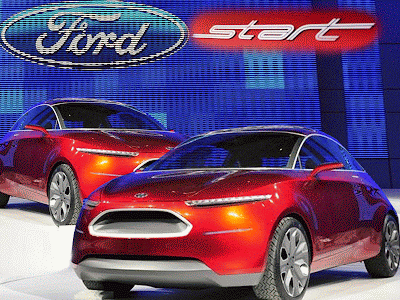
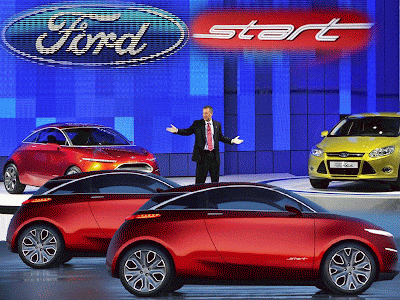
2011 Ford Start Concept Cars MEGA CITY

For parts of the world that are growing increasingly urban, the future of the automobile looks small, green, smart and fun in the eyes of Ford designers who created the Ford Start Concept. It's a design vision inspired for the transportation needs of the world's mega cities.
2011 Ford Start Concept
Making its global debut at the 2010 Beijing Auto Show, the Ford Start Concept is more than simply a design exploration into the feasibility of a small car. It also demonstrates how Ford will extend the promise of its EcoBoost engine technology story even further – previewing a fuel-efficient petrol Ford EcoBoost engine with just three cylinders and 1.0 litre of displacement, yet the power of a larger, 1.6-litre I4 engine.
Start Concept was inspired in part by a growing global trend toward mass urbanisation. The world's top 20 mega-cities are home to consumers whose needs, attitudes and expectations may have more in common with mega-city dwellers in other nations than with their own countrymen. While these consumers share the challenges of living in an urban society, they also increasingly seek out product solutions that bring the best the world has to offer.
When it comes to designing eco-friendly urban transportation, automakers have tried just about everything. They've drawn up bubble cars, autonomic pods, even semi-robotic unicycles. Ford however, has decided against cribbing from the pages of a sci-fi novel and opted for something far more conventional: a three-door hatchback. Specifically, the Start concept the automaker unveiled at the 2010 Beijing Auto Show.
“Our ambition was to design a car that transcends the practical realities of commuting in these mega cities, and goes beyond just dressing the technology,” said Freeman Thomas, design director. “We wanted to design a car you would also love.”
There’s little not to love about the Start, Ford’s first concept in three years, and the first developed under the global auspices of the “One Ford” mantra. Although the Start shows traces of Ford’s “kinetic” design language, its rounded form is much more elegant. Angular edges are limited to both the shoulder lines and the slender, LED-powered headlamp and taillights. Thomas says the Start features “refined surface language” usually found on premium vehicles, and we’d agree -- from some angles, the Start almost resembles Audi’s new A1.
Function doesn’t necessarily follow form, however, as stylists made an effort to improve the car’s aerodynamics. Many surfaces, including the windshield, side window glass, and center stop lamp, are flush with the body, while an underbody aero pan further reduces the Start’s drag. The interior is as equally stylish and functional -- the floating dual-cockpit dashboard lends a sporty look, but a conceptual infotainment system, billed as “MyFord Mobile,” incorporates a multi-function touch screen to simplify the center stack.
While the Start’s form allowed Thomas’ team to flex their creative muscle, the mechanicals beneath the car are firmly rooted in reality. Ford’s teased the idea of an EcoBoost three-cylinder, but this is our first look at such an engine. The turbocharged, 1.0-liter I-3 utilizes a cast-iron block, but a cylinder head and sump fabricated from cast aluminum. Ford won’t talk power figures, saying only that early tests suggest it can produce power on par with its 1.6-liter I-4, which is rated at 120 horsepower in North America. Power is routed to the front wheels via an ordinary five-speed manual transaxle.
Created by a global team of designers working at Ford's Irvine (Calif.) Strategic Concepts Group Studios, this sporty, futuristic concept combines near-production Ford EcoBoost engine technology and slick aerodynamics in an environmentally friendly package with reduced greenhouse emissions, all wrapped in an exciting design.
Ford says the EcoBoost three-cylinder would allow the Start to emit well under 100 grams of carbon dioxide per kilometer. That’s not a crucial figure here in North America, but it is in Europe, where Ford sells the similar-sized Ka. We doubt the Start is destined for production anytime soon, but look for the turbo-three to land in some small European Fords in the near future.
“The Ford Start Concept is the first pure concept we’ve developed under our ‘One Ford’ approach,” says Moray Callum, executive director, Americas Design. “J Mays, Martin Smith and I worked with Freeman and his team to deliver a concept that visually reinforces the fun to drive element that is at the core of the Ford brand DNA.”

Sunday, May 23, 2010

2011 New Renault Sports Cars Megane GT/GT Line


Renault Sports Cars Technologies has helped create two new sporting versions of Renault’s New Mégane – GT and GT Line. 2011 New Renault Mégane GT and GT Line, unveiled at the Geneva Motorshow in March, are available across of the body types that make up the Mégane family (Hatchback, Coupé, Estate, Coupé-Cabriolet) and go on sale in June.
2011 Renault Megane GT/GT Line
Meanwhile, the success enjoyed by New Mégane R.S. – which has already achieved number one status in France, and which holds third place in Germany and Spain – points to a healthy market for Mégane's sporting versions. Building on the reputation and success of its existing performance models, Renault now provides a sporting option for all the body types  that make up the Mégane family.
New Renault Mégane GT and GT Line demonstrate that motoring enjoyment can be affordable, and also serve as eloquent illustrations of Renault's new brand signature, 'Drive the Change' New Renault Mégane GT and GT Line are manufactured in the same factories as those that produce the core-range versions: Palencia (Mégane Hatchback, Coupé and Estate GT and GT Line), and Douai (Mégane Coupé-Cabriolet GT and GT Line).
These new versions bring distinctive styling and genuine driving emotions within reach of as many motorists as possible and also bridge the gap between mainstream Mégane and the allout performance credentials of Mégane R.S. GT Line is a Sport Pack which is available as an option on Mégane Dynamique equipment level versions. They feature a specific chassis and are powered by the Mégane’s core-range of economical and ecological engines. New Renault Mégane GT and GT Line stand out by their sporty styling cues both inside and out. Their sporty character is further accentuated by the Malta Blue body colour (which is exclusive to these versions) and by the Dark Metal (anthracite grey) or polished carbon finish of certain details.
New Renault Mégane Hatchback and Estate GT Line and GT inherit the same 'Sport' chassis as Mégane Coupé. As is the case with Mégane Coupé, the ride height has been lowered by 12mm. The GT Line and GT versions of new Renault Mégane Coupé-Cabriolet place the accent more on comfort and feature the same ride height as the standard model. Further exclusive touches include the polished carbon interior door pull handles, outer air-vents and dashboard trim.
Even more exclusive are the new Renault Mégane GT versions which come with 'GT' badging on the grille and 'GT Renault Sports Cars' badging on the tailgate. They sit on 18-inch Dark Metal-coloured Jetow aluminium wheels. Inside, 'GT' badging figures on the dashboard trim strip and front head rests, along with 'Renault Sport'2 branding on the door sills. Drivers will also appreciate the thick-rimmed leather-trimmed steering wheel incorporating thumb rests that was developed for Renault Mégane RS.
The engines available for new Renault Mégane GT and GT Line have been selected to meet customer demand and match the performance characteristics of each version. New Renault Mégane GT Line are available with the same engines as the mainstream Renault Mégane range and deliver a combination of driving comfort and impressive fuel consumption. GT versions are powered by the Renault Mégane range's more potent, more exclusive powerplants for even greater performance. The more exclusive Renault Mégane GT is available with either of the Mégane range's two most powerful turbocharged engines: the petrol TCe 180 or the diesel dCi 160.
The TCe 180 Euro5 (132kW) is a new evolution of the turbocharged 2.0-litre petrol engine and delivers outstanding driving enjoyment. With peak torque of 300Nm at 2,250rpm, it is extremely responsive and provides exceptional pick-up from low revs thanks to its twin-scroll turbo and continuously variable camshaft angle at the intake port which optimizes airflow into the combustion chambers and enables the turbine to spin up to speed more quickly. The turbo responds to the slightest touch of the accelerator from as low as 1,200rpm. This engine drives through a six-speed manual gearbox.
The dCi 160 Euro5 (118kW) is derived from the Alliance's 2.0-litre diesel turbo engine and is acclaimed as one of the most efficient of its class. With peak torque of 380Nm available from as low as 2,000rpm, this engine climbs smoothly and swiftly up the revs to 5,000rpm. Its 1,600-bar fuel injection rail, piezoelectric injectors, the advanced form of its pistons and its variable geometry turbo all contribute to making this four-cylinder diesel engine one of the most efficient in its class. The two balancer shafts efficiently filter out vibrations and contribute to an exceptionally quiet ride for even greater driving pleasure and comfort. The dCi 160 Euro5 engine is mated to a six-speed manual gearbox.
Related Posts Plugin for WordPress, Blogger...

bmw concept car hybrid